Consultation
 Open an account

Wholesale and retail trade for January–August 2026
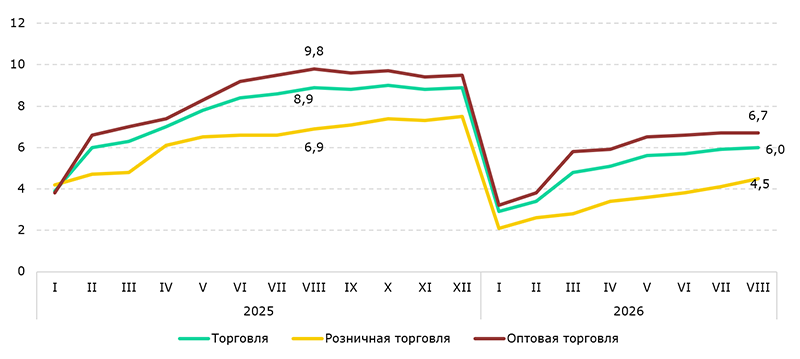
The domestic trade sector remains an important indicator of economic activity. In January-August 2026, according to data from the Bureau of National Statistics (BNS), the annual growth rate of trade was 6.0% compared to +8.9% for the same period last year. In retail trade, the annual growth rate for January-August was 4.5% (+6.9% for 8M2025), while in wholesale trade it was 6.7% (+9.8% for 8M2025).
Wholesale trade, which accounts for the main share of turnover, continues to shape the overall dynamics of the industry. Its share in the total trade volume is about 67%, while retail trade accounts for 33%. The growth indicators of wholesale trade have slowed down due to a decrease in oil production volumes, as well as more moderate business investment activity.
The dynamics of retail trade continue to be influenced by changes in consumer demand, household expenditure structure, and the gradual cooling of consumer lending. Meanwhile, within the retail segment, there is differentiation: sales of food products increased by 10% year-on-year, while sales of non-food products rose by 1.8%.
The domestic trade sector is one of the key indicators of economic activity. In January-August 2026, the growth rate of domestic trade was 6.0% year-on-year, down from 8.9% year-on-year in the same period of 2025 (Fig. 1). The current slowdown in growth rates is consistent with data from the Halyk Business Index, which is published on the website halykmacro.kz.
Fig. 1. Dynamics of domestic trade, % year-on-year
Source: BNS
The growth rate of wholesale trade was 6.7% year-on-year, compared to 9.8% year-on-year for January-August 2025. The wholesale segment accounts for 67.1% of the total industry turnover, making it the main factor in the overall trade dynamics. The structure of wholesale turnover is dominated by non-food products and industrial goods (79.8%), reflecting the significant role of the wholesale segment in ensuring commodity flows in the economy.
The more moderate growth rates of wholesale trade compared to last year may be partly attributed to a decline in oil production—the Ministry of Energy adjusted the 2026 plan from 98 to 96 million tons due to disruptions in the Caspian Pipeline Consortium’s operations—as well as more restrained investment activity in certain sectors of the economy: mining (-3.9% year-on-year for 8M2026) and transport (+4.8% year-on-year). Indirect evidence of this link can be seen in the structure of wholesale turnover by region: the Atyrau region, where a significant portion of oil production is concentrated, ranks third in the total volume of wholesale trade.
In January-August 2026, the largest share of total wholesale trade was accounted for by Almaty (35.7%), Astana (14.1%), the Atyrau region (13.4%), and Shymkent (6.3%).
In retail trade, the growth rate in January-August was 4.5% year-on-year. For comparison, in the same period of 2025, growth was 6.9% year-on-year. Food products account for 34.1% of total retail trade, while non-food products account for 65.9%. The dynamics of retail turnover are influenced by changes in consumer demand structure: while the overall growth rate of retail trade is slowing, the food segment shows higher dynamics (+10% year-on-year) compared to non-food products (+1.8% year-on-year). Food products are essential goods with stable demand, whereas demand for non-food products—especially durable goods—is more sensitive to borrowing costs, lending conditions, and overall consumer caution. The cooling of consumer lending, driven by regulatory measures, as well as persistent inflationary pressure, are also restraining retail turnover.
The main channel for goods sales is private trading enterprises—89.2% of the total retail volume. Small businesses, including individual entrepreneurs, account for the majority (68.1%) of turnover from retail trading enterprises, which suggests that the above dynamics of retail trade primarily affect small enterprises.
In January-August 2026, the largest share of total retail trade was accounted for by Almaty (32.3%), Astana (14%), the Karaganda region (7%), and the East Kazakhstan region (5.4%).
Thus, trade maintains positive dynamics despite a slowdown in growth rates compared to last year. The resilience of the sector is primarily supported by wholesale trade and the food segment of retail.
Arslan Aronov – Analytical Center
When using material from this publication, a reference to the original source is required.