Consultation
 Open an account

Investments in fixed assets for 8M2026
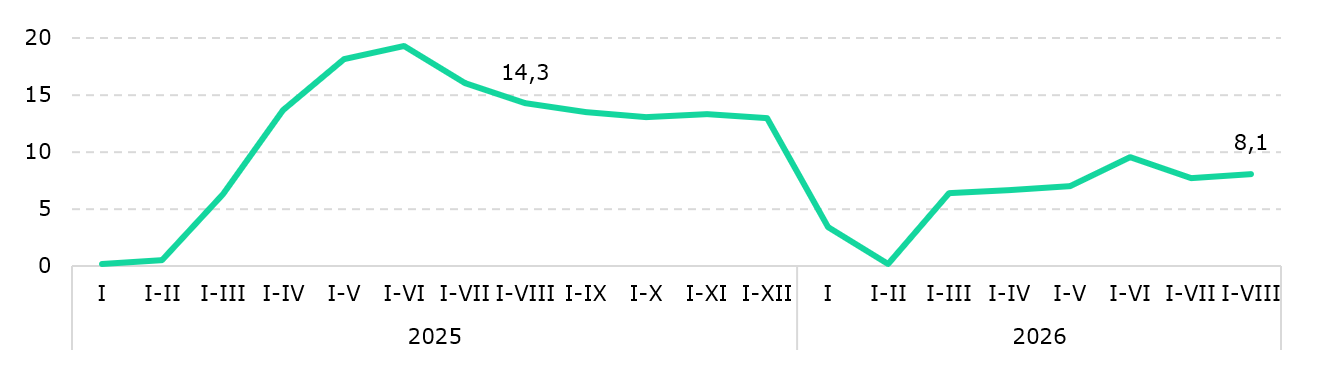
Investments in fixed capital in January-August 2026 increased by 8.1% year-on-year (+14.3% y/y for 8M2025). Growth in investments was supported by the expansion of debt financing amid a reduction in the role of budgetary funds in the investment structure. The state's participation in the investment process is maintained through the own funds of state-owned companies, which play a significant role in the economy.
The highest year-on-year growth in investments among key economic sectors was recorded in the electricity supply sector due to an increase in own and borrowed, including credit, financing. We assume that the growth in borrowed funds was driven by lending from state development institutions.
We expect that in the medium term, state participation in the investment process will be maintained through large-scale programs for concessional business financing, external borrowings, and increased transfers from the National Fund. In this regard, the relevance of creating conditions for further expansion of private investments and diversifying investment flows with a focus on technological modernization of the economy remains. According to our estimates, by the end of the current year, the growth rate of investments will show a more moderate dynamics than in 2025.
In January-August 2026, growth in fixed capital investments (FCI) amounted to 8.1% y/y (+14.3% y/y in January-August 2025). This dynamics is associated with a decrease in budgetary financing, which was offset by growth in financing through own and borrowed funds. Excluding budgetary funds and funds from individual developers, the investment dynamics show significant growth, which for January-August amounted to 19.0% y/y.
Fig. 1. Dynamics of fixed capital investments, % y/y
 Source: BNS
The predominant source of investment financing is the own funds of economic entities, whose share increased to 66.7% (63.4% for 8M2025), remaining below the 8M2024 level (67.8%) (Table 1). The share of budgetary funds decreased from 23.0% in January-August 2025 to 14.0% in the same period of 2026. A possible reason for the reduction in the share of state financing in investments may be the planned decrease in transfer volumes from the National Fund (NF). It should be noted that the category of own funds often includes funds from state-owned companies, which are essentially quasi-budgetary funds; therefore, it can be assumed that the actual level of state participation in investments is higher.
The share of bank loans increased from 3.4% in January-August 2025 to 5.6% for 8M2026. We assume that the reduction in budgetary financing is compensated by the expansion of credit instruments, including through the Development Bank of Kazakhstan (DBK) and other state development institutions, which also affects the level of state participation in the investment process.
Table 1. FCI by sources of financing
| Investments | % of total, 8M2024 | % of total, 8M2025 | % of total, 8M2026 |
| FCI, including funds from: | 100.0 | 100.0 | 100.0 |
| state budget | 18.5 | 23.0 | 14.0 |
| own funds | 67.8 | 63.4 | 66.7 |
| bank loans | 3.6 | 3.4 | 5.6 |
| other borrowed funds | 10.1 | 10.1 | 13.7 |
Source: BNS
In January-August 2026, budgetary investments were mainly directed to three sectors: transport (36.0%), water supply (11.6%), and electricity supply (10.2%). Other major state investments were distributed among education, healthcare, and other social areas.
Among key industries, significant growth in investments was demonstrated by agriculture (+17.6% y/y), manufacturing (+39.9% y/y), electricity supply (+49.3% y/y; due to significant borrowings), construction (+40.0% y/y), and communications (+45.3% y/y).
A decline in investments in January-August 2026 compared to the same period last year was observed in mining (-3.9% y/y), finance (-17.0% y/y), as well as in sectors funded from the budget: water supply (-14.7% y/y) and education (-68.3% y/y).
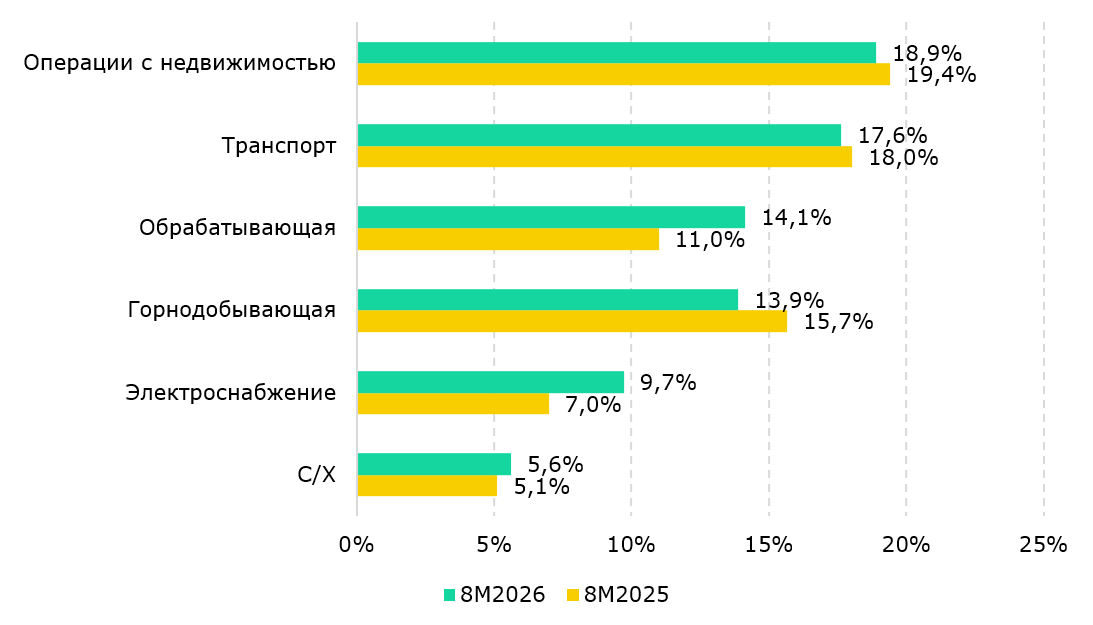
Fig. 2. Sectoral structure of investments, %
 Source: BNS
Note: sectors with a share of less than 5% are excluded
In the sectoral structure of investments, the real estate sector continues to hold a leading position with a share of 18.9%. Due to increased investments in the electricity supply sector, its share in the total FCI grew from 7.0% for 8M2025 to 9.7% for 8M2026 (Fig. 2). Thanks to significant growth in investments in manufacturing and a decline in mining, the share of manufacturing in total investments exceeded that of mining - 14.1% versus 13.9%. The accelerated growth in capital investments in manufacturing relative to mining contributes to diversification and a shift in the economy's structure toward non-commodity sectors. It should be noted that the growth in investments in manufacturing is driven by increased investments in food production (+120.6% y/y), chemical products (+87.1% y/y), pharmaceutical products (+38.2% y/y), and electrical equipment (+81.8% y/y), which together account for 41% of all investments in manufacturing.
In the purpose structure of FCI, construction and major repairs of buildings and structures predominate - their share in the total FCI was 62.9% in January-August 2026 (68.3% for 8M2025), while the share of investments in machinery and equipment was 32.8% (27.2% for 8M2025). Construction costs are largely financed by the state budget as part of infrastructure and other projects. Accordingly, a reduction in budgetary investments has led to a decrease in the share of investments in construction and major repairs. The reduction in the share of budgetary financing does not exclude the preservation of state influence on the investment process through various state development institutions, in particular through external and domestic borrowings.
Overall, the implementation of previously announced state programs for large-scale attraction of funds in the coming years to provide concessional financing for the economy will contribute to increasing the role of the state in investment activities. We expect that the growth rate of FCI this year will be more moderate than in 2025 amid a decrease in transfer volumes from the National Fund. For sustainable and high-quality long-term economic development, it is important to maintain a balance between state and private sources of financing, as well as to stimulate investments in technological transformation and innovation, creating additional conditions for expanding private investments.
Arslan Aronov – Analytical Center
Alena Safonova – Analytical Center
When using material from this publication, a reference to the primary source is mandatory.