Consultation
 Open an account

GDP and FEA for January-August 2026: manufacturing and construction drive growth
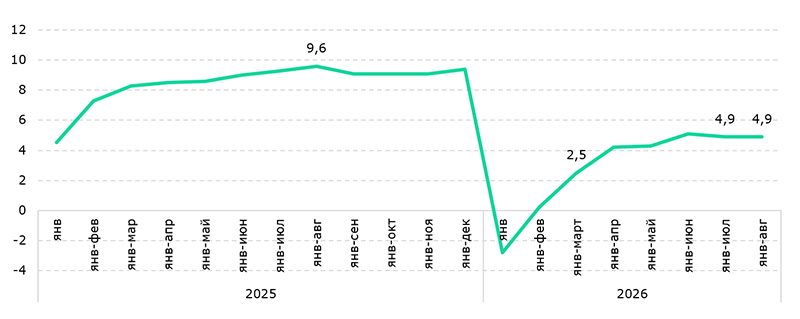
According to data from the Ministry of National Economy (MNE), annual GDP growth over eight months amounted to 4.1% (+6.5% for 8M2025). According to the Bureau of National Statistics (BNS), the short-term economic indicator (SEI), which reflects the dynamics of key economic sectors, stood at 4.9% year-on-year for January–August of the current year (+9.6% for January–August 2025).
The overall slowdown in economic growth compared to last year is linked to a decline in oil production throughout the current year, which, through a multiplier effect, has impacted the dynamics of sectors related to oil extraction (transport, wholesale trade). High growth rates are maintained in the construction sector, supported by infrastructure projects largely financed by budgetary funds. Growth in manufacturing and agriculture is driven by investment inflows into fixed capital. We expect GDP growth of 4.8% in 2026, with possible growth rates of 4.5–4.8% in the following year.
According to MNE data, GDP growth over eight months of the current year amounted to 4.1% year-on-year. According to BNS data, the SEI for January–August 2026 was 4.9% year-on-year (+9.6% year-on-year for 8M2025). After a decline at the beginning of the year, the SEI gradually increased to 4.9% year-on-year by the end of seven and eight months (Figure 1).
Figure 1. SEI dynamics, % year-on-year
Source: BNS
According to BNS data, industrial sector growth over eight months was 2.8% year-on-year, compared to +7.6% year-on-year in the same period of 2025. The main reason for the slowdown is the dynamics in the mining industry, where production volumes declined by 4.3% year-on-year after growing by 9.6% year-on-year a year earlier. This decline was linked to a reduction in oil production volumes: in physical terms, oil production fell by 8.3% year-on-year in January–August 2026, which was associated with temporary activity suspensions at Tengiz and CPC. This trend in the mining sector aligns with data from the Halyk Business Index, published on the website halykmacro.kz.
In the manufacturing sector, high growth rates of 8.4% year-on-year are maintained (+6.5% year-on-year for 8M2025). Key growth components include food production (+12.9% year-on-year), chemical industry (+27.3% year-on-year), and machine building (+21.2% year-on-year), which account for 13%, 5%, and 17% of the manufacturing sector’s output, respectively. Metallurgy, as the main component of this sector (42% of output), saw a decline of 2.7% year-on-year.
Annual growth in the trade sector slowed from 8.9% in January–August 2025 to 6.0% over the first eight months of the current year. Wholesale trade continues to account for the majority (67%) of the sector’s turnover, with growth at 6.7% year-on-year after +9.8% year-on-year in January–August of the previous year. This trend is driven by the multiplier effect of reduced oil production. Retail growth was 4.5% year-on-year (+6.9% year-on-year for 8M2025), reflecting a slowdown in non-food sales growth to +1.8% year-on-year. In our view, this reflects cooling consumer lending.
Table 1. Dynamics of SEI and sectors, % year-on-year
|
Name |
8М2024 % y/y | 12М2024 % y/y | 8М2025 % y/y | 12М2025% y/y | 6М2026 % y/y | 7М2026 % y/y | 8М2026 % y/y |
| GDP | 3,7 | 5,0 | 6,5 | 6,5 | 4,1 | 4,1 | 4,1 |
| Short-term economic indicator | 4,4 | 6,2 | 9,6 | 9,4 | 5,1 | 4,9 | 4,9 |
| Trade | 5,5 | 9,1 | 8,9 | 8,9 | 5,7 | 5,9 | 6,0 |
| Manufacturing | 4,9 | 5,9 | 6,5 | 6,4 | 9,8 | 9,0 | 8,4 |
| Mining | 1,0 | -0,2 | 9,6 | 9,4 | -4,0 | -4,4 | -4,3 |
| Transport | 7,9 | 8,5 | 21,5 | 20,4 | 7,1 | 7,4 | 7,3 |
| Construction | 8,8 | 13,1 | 18,1 | 15,9 | 15,2 | 15,3 | 15,6 |
| Agriculture | 3,7 | 13,7 | 3,4 | 5,9 | 4,4 | 5,0 | 5,2 |
| Communications | 7,4 | 5,0 | 3,8 | 3,6 | 4,3 | 4,3 | 4,4 |
Source: BNS
Transport sector growth was 7.3% year-on-year, compared to 21.5% year-on-year for January–August 2025. The sector’s dynamics were shaped against a high base in 2025, as well as a slowdown in freight turnover—from 12.1% year-on-year in 8M2025 to 0.8% year-on-year in 8M2026. The main constraint was a 2.4% year-on-year decline in pipeline freight turnover amid reduced oil production, as this segment accounts for a third of the transport sector’s total freight turnover.
Passenger turnover in the sector grew by 7.0% year-on-year (+10.0% year-on-year for 8M2025). In the bus transport segment, which accounts for over 43% of the transport sector’s passenger turnover, growth was 8.4% year-on-year (+15.1% year-on-year for 8M2025), which may have influenced the overall passenger turnover dynamics.
The construction sector continues to exhibit the highest growth rates among key SEI sectors. Over January–August, construction work volumes increased by 15.6% year-on-year, compared to 18.1% year-on-year a year earlier. One factor influencing the sector’s dynamics is the implementation of state-funded infrastructure projects. The slight slowdown in growth rates, in our view, is linked to a possible reduction in infrastructure project financing due to lower transfers from the National Fund compared to 2025.
In agriculture, growth accelerated to 5.2% year-on-year after 4.4% year-on-year in the first half and 3.4% year-on-year in January–August 2025. The dynamics were also driven by the harvest campaign and the arrival of the new harvest, supported by industry subsidies.
The communications sector grew by 4.4% year-on-year over eight months, exceeding the January–August 2025 figure (+3.8% year-on-year) thanks to a 145% year-on-year increase in mobile services volumes, despite a 34.6% year-on-year decline in internet services. This trend is linked to a change in accounting methodology: since 2026, mobile internet services have been reclassified under the “mobile communications” category.
Overall, the structure of economic growth is characterized by high growth rates in a number of non-commodity sectors, primarily manufacturing and construction. Growth in the construction sector is largely reliant on budgetary financing, the volume of which is capped.
The oil and gas sector continues to significantly influence key macroeconomic indicators through its multiplier effect. We expect GDP growth to accelerate to 4.8% year-on-year by the end of the current year amid a gradual recovery in oil production. In 2027, growth rates are projected to remain at 4.5–4.8% year-on-year due to planned technical works at Kashagan and Tengiz, which will temporarily limit oil production. In our view, additional transfers from the National Fund, earmarked for financing infrastructure projects, will support growth in 2027, contributing to higher growth rates in the construction sector.
Arslan Aronov – Analytical Center
When using material from this publication, a reference to the original source is required.