Consultation
 Open an account

The construction sector for 8M2026: growth amid infrastructure project implementation
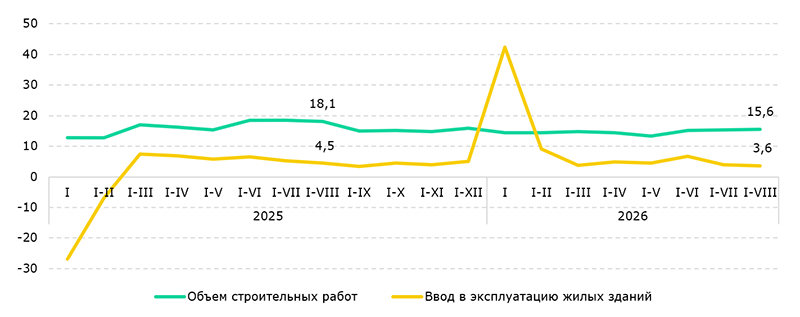
According to data from the Bureau of National Statistics (BNS), over the first eight months of the current year, the construction sector grew by 15.6% year-on-year (+18.1% for 8M2025). Construction continues to be the fastest-growing segment among key economic sectors. The current growth structure is largely linked to the implementation of large-scale infrastructure and investment projects, including those involving the state and quasi-state sectors.
A more moderate performance in the construction sector, in our view, may be associated with the high base of the previous year and changes in budget financing volumes, including transfers from the National Fund. Next year, construction dynamics may be supported by an expansion of financing sources for investment projects, including potential domestic and external borrowings by the government and state-owned companies, as well as changes in the volume of transfers from the National Fund, part of which may be directed toward financing investment projects, including state investments under the National Project “Modernization of the Energy and Utilities Sectors.”
According to the BNS, over the first eight months of 2026, the growth rate of construction work volumes reached 15.6% y/y, compared to +18.1% y/y for 8M2025. Housing input growth rates show a similar trend: a slowdown from 4.5% y/y over the first eight months of 2025 to 3.6% y/y for the same period this year (Fig. 1).
Fig. 1. Dynamics of construction work, % y/y
Source: BNS
Construction of facilities accounts for more than 54% of the total construction work volume. This segment saw a slowdown in growth from 24.8% y/y for 8M2025 to +20.0% y/y in the same period this year. Meanwhile, non-residential building construction, which accounts for 29.7% of the total work volume, showed an acceleration in growth to 12.8% y/y, compared to +9.4% y/y for 8M2025.
A significant portion of construction work for January-August of the current year fell within the segment of engineering structures related to the implementation of infrastructure projects and programs. The dynamics in this segment were driven by growth in the construction of railways, subways, power lines, telecommunications, water supply pipelines, as well as an increase in electrical installation work, which together account for about 21% of the total construction work volume. This trend may be linked to large-scale modernization of railway tracks, as well as energy and utilities infrastructure, including pipeline and sewer networks, in line with the National Project “Modernization of the Energy and Utilities Sectors.” An additional growth driver in the railway and subway construction segment is the implementation of a major light rail transit project in Astana.
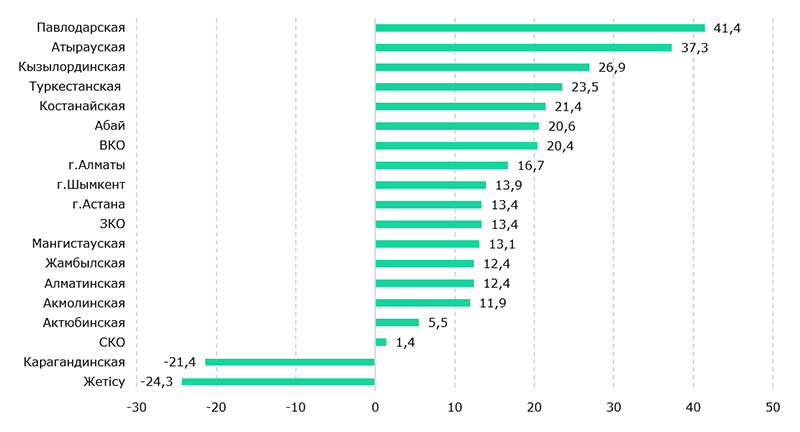
The dynamics of construction work in Kazakhstan show significant regional differentiation (Fig. 2). According to the BNS, the highest growth rates were recorded in the Ulytau (+189.8% y/y), Pavlodar (+41.4% y/y), and Atyrau (+37.3% y/y) regions. Growth in these regions is largely tied to the implementation of large-scale state programs for updating utilities and railway infrastructure. In the capital, growth stood at +13.4% y/y, driven by major transport and infrastructure projects.
Fig. 2. Growth rates of construction work volumes by region for 8M2026, % y/y
 Source: BNS
Note: Ulytau region excluded due to high growth rate (+190% y/y)
The volume of construction work for residential buildings increased by 13% y/y for 8M2026 — a rate comparable to the 8M2025 figure. The growth rate of housing input slowed from 4.5% y/y in January-August 2025 to +3.6% y/y for 8M2026. About 96% of the housing input volume was provided by private developers. Construction work indicators vary by region: over the first eight months of the current year, Astana and Almaty saw 2.7 and 1.8 million sq. m. of housing input, respectively, accounting for about 40% of the national total.
Overall, Kazakhstan’s construction sector in 2026 maintains high growth rates; however, growth structure is uneven across segments and regions. At this stage, the industry is developing primarily due to infrastructure projects, with varying construction activity intensity across regions.
Further sector dynamics will depend on the combination of private demand, infrastructure programs, and the distribution of investment activity across regions. We expect high growth rates in the construction sector to continue next year, supported by increased financing for infrastructure projects, including budget sources and transfers from the National Fund.
Special attention should be given to the ratio of growth rates in the construction industry and building materials production: according to the Ministry of National Economy, building materials production grew by 7% for 8M2026, while the construction industry grew by 15.6%. With further expansion of construction activity in 2027, including amid expected increases in National Fund transfers for infrastructure projects, maintaining such a ratio of growth rates could impact construction costs, and, if material imports rise, also affect demand for foreign currency.
Arslan Aronov – Analytical Center
Anna Borshch – Analytical Center
When using material from this publication, a reference to the primary source is mandatory.