Consultation
 Open an account

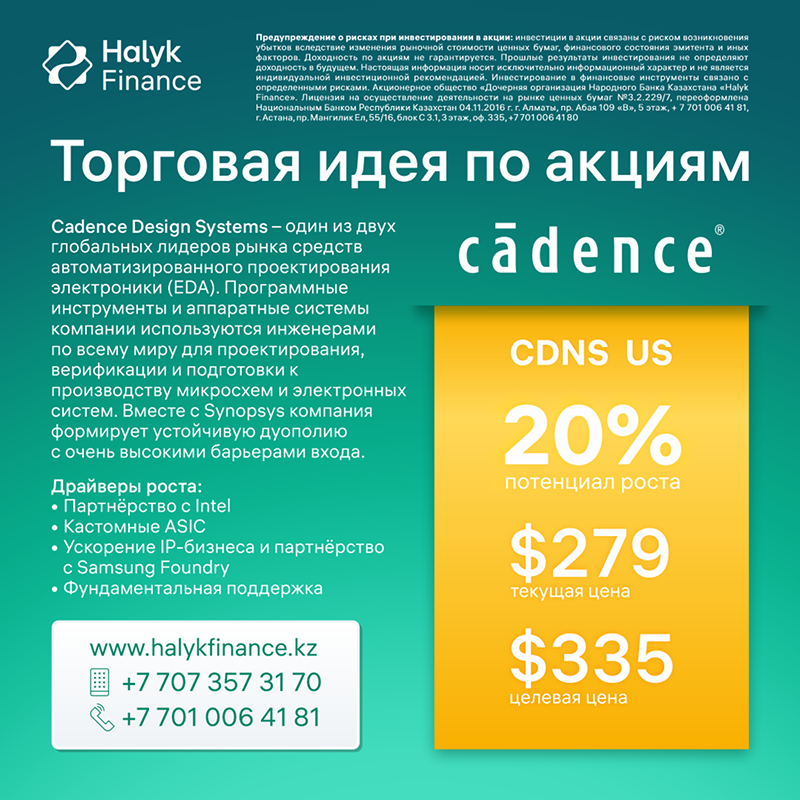
Halyk Finance Trading Idea: Cadence Design Systems
17 September 2026
DownloadCadence Design Systems – is one of the two global leaders in the market for electronic design automation (EDA) tools. The company's software tools and hardware systems are used by engineers worldwide to design, verify, and prepare for the production of chips and electronic systems. The customer base spans semiconductor manufacturers, hyperscalers, automotive, aerospace and defense industries, as well as developers of communications systems and data centers. Together with Synopsys, the company forms a stable duopoly with very high barriers to entry.
Growth drivers:
- Partnership with Intel – the recent expansion of collaboration with Intel on the advanced 14A process represents a multi-year opportunity. Cadence has historically been underrepresented at Intel, so the potential for increasing its share is significant. The collaboration goes beyond contract manufacturing and opens up product opportunities, including the Palladium platform and a suite of digital implementation tools.
- Custom ASICs – Cadence sees several collaboration opportunities with developers of advanced AI models, both directly and through semiconductor partners designing custom ASICs for hyperscalers. The growing number of companies creating their own chips and the increasing number of design options are driving demand for Cadence's entire product portfolio. This effect is already evident in the numbers, as the company reported record backlog in the first and second quarters, and the quality of the backlog is improving due to deeper engagement with major customers.
- Accelerating IP business and partnership with Samsung Foundry – the intellectual property business is showing above-average growth, with second-quarter revenue up more than 40 percent, driven by accelerating demand for hardware design verification solutions. Demand is being driven by customers in the AI and high-performance computing segments, which are being joined by the automotive industry and robotics.
- Fundamental support – despite a seasonally weaker first half and a relatively light renewal year in 2026, the company increased its backlog in the first and second quarters, and recurring revenue grew by approximately 18–20% year-over-year. In the long term, management sees the potential for recurring business growth at a rate of around 15–20% due to deeper customer relationships, increased use of core tools, and growing design complexity.